Powering academic wireless innovation
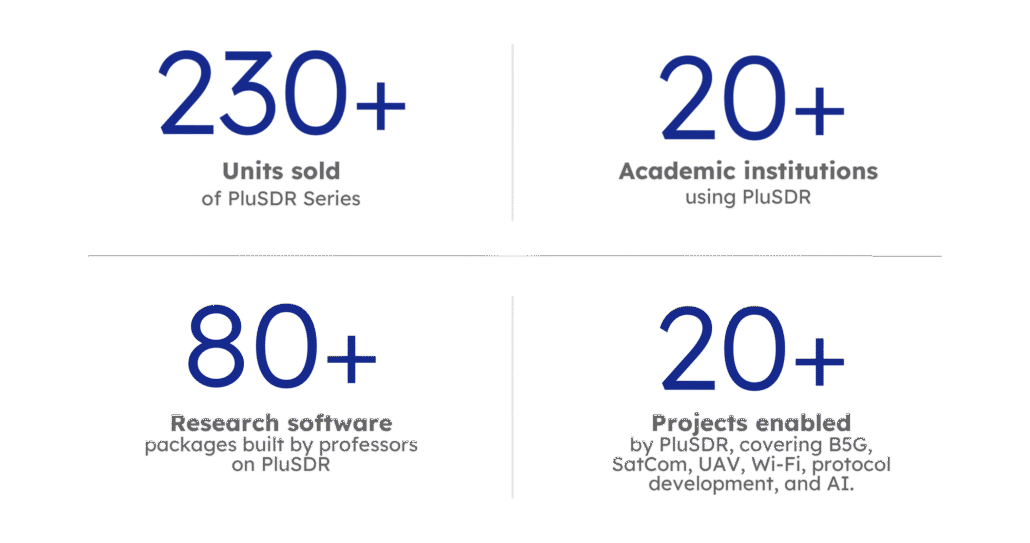
A proven SDR platform trusted by universities and researchers

A proven SDR platform trusted by universities and researchers
A proven SDR platform trusted by universities and researchers
YTTEK’s academic solutions integrate a flexible SDR platform with a wide frequency range from 10 MHz to 15 GHz, seamlessly connected to mmWave front-ends, up/down converters, and liquid-crystal RIS via our exclusive DCI interface—enabling cost-effective development and testing for B5G, 6G, and satellite communications.

At the heart of every YTTEK solution is a highly flexible SDR architecture. Powered by FPGA, our SDR platforms deliver real-time reconfigurability and seamless integration—helping innovators to adapt to evolving communication standards without hardware changes.
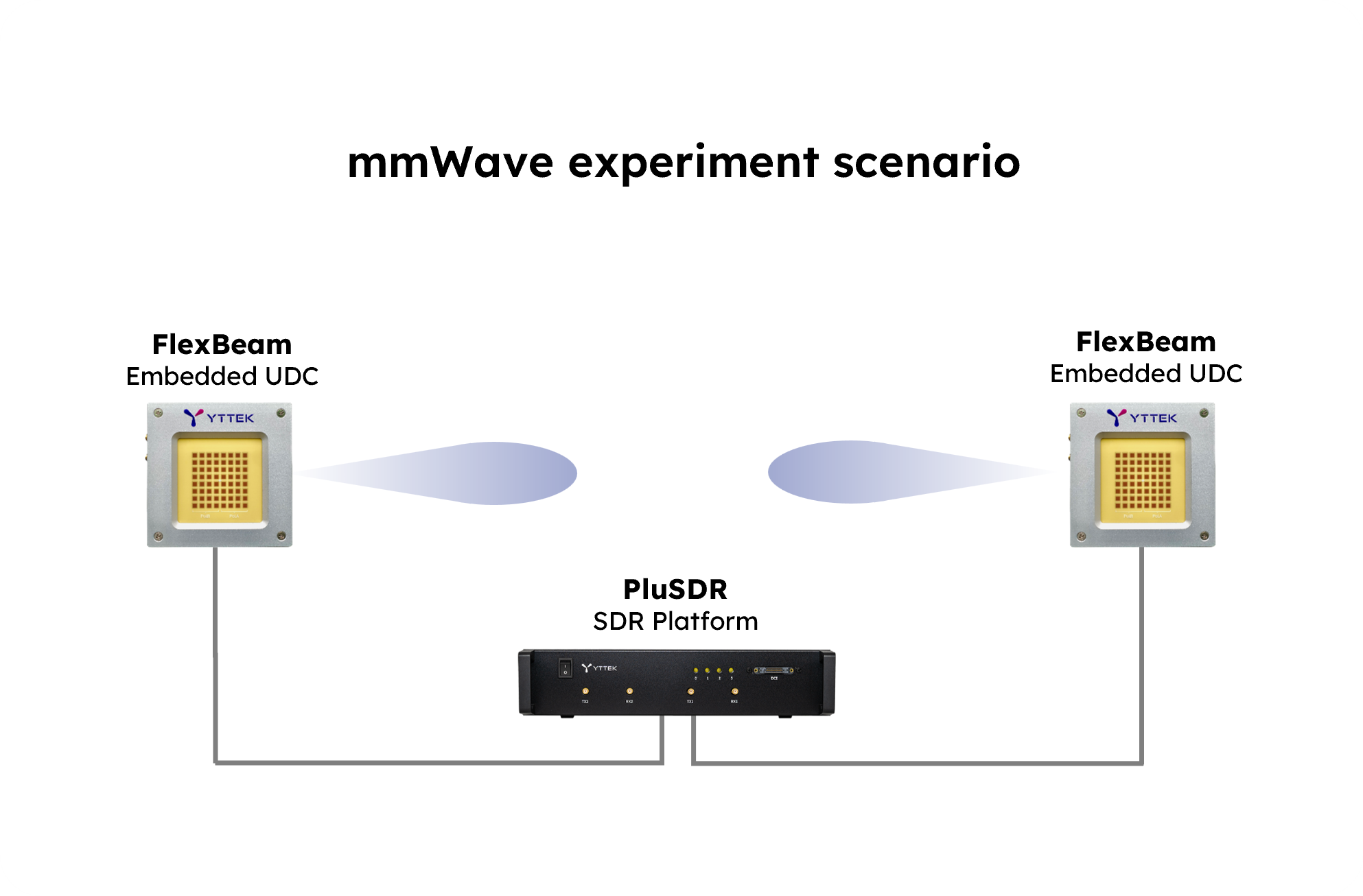
YTTEK’s academic solutions feature an exclusive DCI interface, enabling seamless, cost-effective integration of SDR, mmWave front-end module (FEM), up/down converters(UDC), and RIS – eliminating extra hardware and reducing deployment complexity.
Replaceable antenna modules to fit various test needs.

Choose between configurable FEM with UDC integrated or standalone UDC options.

SDR platform series offers 56, 100, or 400 MHz bandwidth options for diverse research needs.


Proven results in accelerated education

“The YTTEK SDR platform makes research so much easier. I can directly use existing MATLAB code without learning new programming languages. Its near real-time performance helps students grasp theory through practice.”

“The best part of PluSDR Lite is its easy-to-use interface — it lets us capture real signals and quickly convert them into I/Q data.”

“PluSDR empowers my research in signal processing, target tracking, and intelligent antenna tuning effectively.”

“The important thing is that YTTEK’s system is very user-friendly and easy for our students to start with.”

“Past simulation codes in Python, Matlab, or C/C++ could be effortlessly reused, significantly reducing development time.”

“The beauty of PluSDR is its ease of use. Even beginners and students can get started quickly, which significantly reduces the time I need to spend on training.”

What are the advantages of the YTTEK PluSDR SDR platform compared with other SDR platforms?
Compared with open-source and entry-level SDR platforms
The YTTEK PluSDR delivers superior dynamic range (RX gain up to 60 dB with high-resolution stepping), robust clock synchronization stability, and maximum RF output power (up to +20 dBm on selected models), far exceeding the capabilities of consumer-grade open-source SDR platforms to achieve academic, industrial, and defense-grade standards.
Compared with tier-1 global SDR platforms
The YTTEK PluSDR provides a highly cost-effective solution and greater system architecture flexibility. For research institutions, Unmanned Aerial Vehicle (UAV) Command and Control (C2) data link developers, and satellite payload or ground station antenna developers worldwide, YTTEK is backed by deep expertise in comprehensive Physical Layer (PHY) communications and product development. This allows us to provide technical support for customized modifications, development, and validation to seamlessly cater to the unique design requirements of specialized wireless systems, particularly for UAV and Low Earth Orbit (LEO) satellite communications.
By combining high-performance hardware with extensive, developer-friendly example code, PluSDR has gained recognition and been adobpted by the leading space agency TASA (Taiwan Space Agency), academic institutions, and advanced wireless communication research organizations in Taiwan for 5G/6G and LEO satellite baseband research and validation.
Does the YTTEK PluSDR SDR platform support Integrated Sensing and Communication (ISAC) applications?
Yes. The YTTEK PluSDR platform is well suited for ISAC research and applications.
Key advantages include:
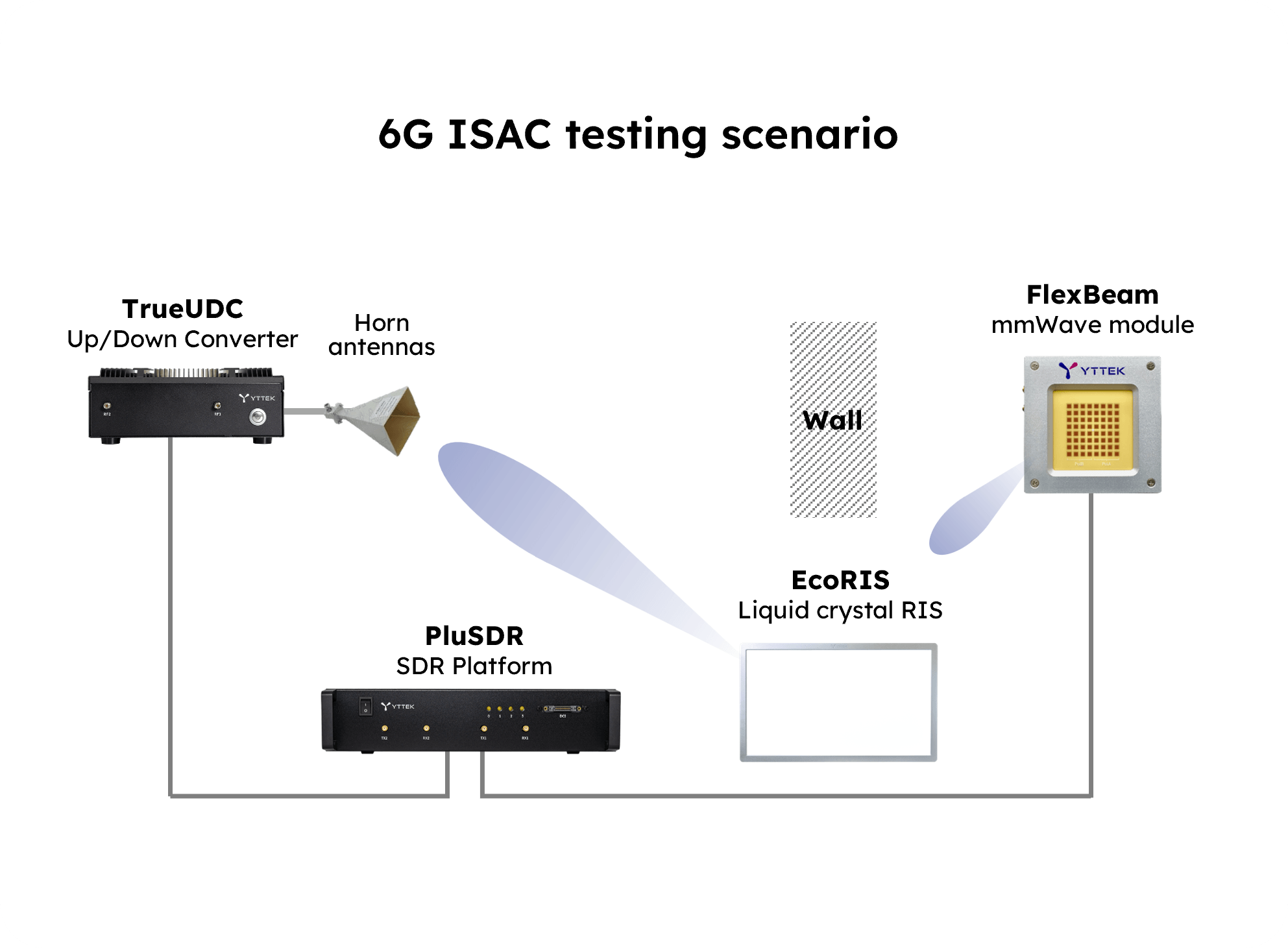
Broad frequency coverage: The PluSDR platform delivers native coverage across Sub-6 GHz and FR3 (up to 15 GHz) frequencies. By integrating YTTEK’s TrueUDC mmWave up/down converter or FlexBeam mmWave module, the system can support operation in FR2 mmWave bands up to 28 GHz.
High sensing resolution: PluSDR delivers precise range resolution with up to 400 MHz of bandwidth, while multi-channel cascading enables high angular resolution for advanced wireless sensinbg applications.
Efficient algorithm validation: It supports user-defined communication and radar shared waveforms (e.g., OFDM-based radar), featuring a software-friendly ecosystem that simplifies development and testing.
Advanced research expansion with RIS: Combined with YTTEK EcoRIS liquid crystal technology, PluSDR supports research on using RIS to bypass obstacles for non-line-of-sight (NLOS) sensing and communication.
Does the YTTEK PluSDR SDR platform provide FPGA access for custom development?
Yes. The YTTEK PluSDR platform provides comprehensive Physical Layer (PHY) integration support, enabling a streamlined transition from high-level simulation to FPGA implementation and chip-level hardware realization. This architecture is ideally suited for engineering teams seeking to translate algorithms into hardware implementations.
MATLAB & Simulink integration: Developers can perform fixed-point simulation of specific functions or algorithms in MATLAB, then use HDL Coder or custom RTL design workflows to generate FPGA-ready HDL code (VHDL or Verilog).
Seamless integration with Vivado: Generated Verilog can be directly imported into the Xilinx Vivado environment and integrated within the PluSDR FPGA framework, enabling logical bridging with PHY layer RF control IP blocks, including Analog-to-Digital Converter (ADC) / Digital-to-Analog Converter (DAC) drivers, Digital Down Conversion (DDC), and Digital Up Conversion (DUC).
Does the YTTEK PluSDR SDR platform support PCIe interface cards?
No. The YTTEK PluSDR platform does not support PCIe interface cards.
Instead, it provides flexible high-speed connectivity to PCs and laptops through:
• RJ45
• SFP
• QSFP
Does the YTTEK PluSDR SDR platform support Multiple-In Multiple-Out (MIMO)?
Yes. The YTTEK SDR platform series supports a range of MIMO configurations without requiring additional expansion hardware. PluSDR Lite provides native 2TX/2RX independent RF chains, while the PluSDR offers 2TX/2RX or 4TX/4RX independent RF chains depending on the selected model.
With these built-in RF channels, a single PluSDR unit can perform advanced MIMO experiments without additional expansion hardware, including:
• 2×2 MIMO spatial multiplexing
• Space-Time Block Coding (STBC), such as the Alamouti scheme
• 4×4 antenna array beamforming
Scalable expansion for Massive MIMO
For advanced research scenarios such as private 5G networks, 6G, and LEO satellite tracking, larger MIMO configurations such as 8×8, 16×16, and beyond are often required. PluSDR supports synchronized multi-unit expansion to enable scalable antenna array experimentation. Key capabilities include:
Precise phase and clock synchronization: Each PluSDR unit includes 10 MHz REF IN / REF OUT interfaces located on the rear panel to distribute a common reference clock and ensure identical Local Oscillator (LO) frequencies across all SDR units.
Multi-unit cascading via clock buffer module: By utilizing a dedicated clock buffer module, users can cascade up to four 4×4 PluSDR units.
Example configurations:
• 2 cascaded 4×4 PluSDR units → 8×8 MIMO
• 4 cascaded 4×4 PluSDR units → 16×16 Massive MIMO
Does the YTTEK PluSDR SDR platform support multi-unit synchronization?
Yes. The YTTEK PluSDR supports synchronized multi-unit operation to enable large-scale antenna arrays (Massive MIMO).
Key synchronization features include:
Precise phase and clock synchronization: Each PluSDR unit includes 10 MHz REF IN / REF OUT interfaces located on the rear panel to distribute a common reference clock and ensure identical LO frequencies across all SDR units.
Multi-unit cascading via clock buffer module: By utilizing a dedicated clock buffer module, users can cascade up to four 4×4 PluSDR units.
Example configurations:
• 2 cascaded 4×4 PluSDR units → 8×8 MIMO
• 4 cascaded 4×4 PluSDR units → 16×16 Massive MIMO

• Covers frequencies from 10 MHz to 15 GHz
• Up to 400 MHz bandwidth
• Intuitive, free example code included
• Applicable to multiple wireless communication standards
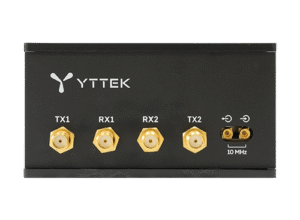
• Covers frequencies from 300 MHz to 6 GHz
• Up to 100 MHz bandwidth
• Intuitive, free example code included
• Applicable to multiple wireless communication standards

• Detachable antenna module for flexible antenna swapping
• Highly integrated FEM with embedded UDC & beamformer
• Dual arrays with independent RHCP/LHCP control for real-world simulation
• 6-bit phase resolution achieves precise beamforming

• Frequency drift under 5 ppb
• Supports 5G mmWave and Ka-band LEO applications
• Wide IF frequency range: 2.6 GHz to 5.8 GHz
• Two-way RF output for dual-polarization antenna arrays

• Liquid-crystal RIS with ultra-low 2 W power consumption
• Electronically steerable beam at arbitrary angles
• Micro-scale metasurface with 33,154 cells delivers 2× efficiency
• Large surface boosts total gain up to 70 dB for stronger signals