How software-defined radio (SDR) powers the next generation of UAV communication modules
Insights
As drone applications expand across defense, industrial, and commercial sectors, the demand for flexible, secure, and future-proof drone communication modules is rapidly increasing. Drones—also known as unmanned aerial vehicles (UAVs)—now require communication systems that can adapt to evolving mission and operational requirements.
Traditional hardware-based drone communication modules struggle to provide the flexibility needed for modern UAV operations. In contrast, Software-Defined Radio (SDR), also known as drone SDR, provides a reconfigurable and cost-efficient architecture that enables long-term scalability.
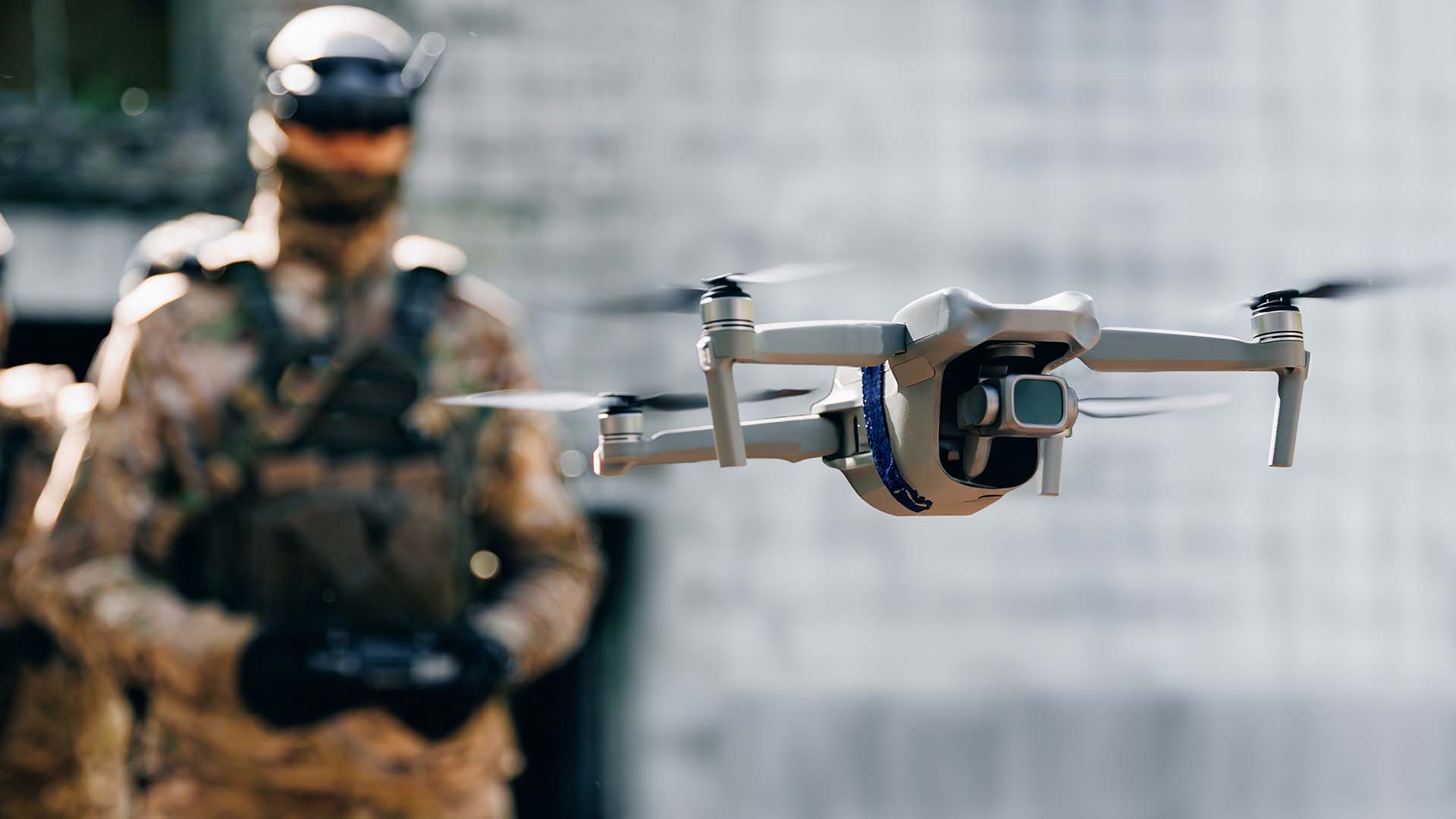
What is SDR and why it matters for UAV communication modules?
“Software-Defined Radio (SDR) replaces fixed hardware circuits with programmable software logic. Functions such as modulation, demodulation, filtering, and frequency selection are implemented through software running on FPGA-based architectures instead of custom ICs,” explained Dr. RJ Chen, Director of Research & Development at YTTEK.
Unlike conventional radios limited to a single waveform or frequency band, SDRs can dynamically reconfigure themselves—switching across frequencies, waveforms, and communication standards.
Think of traditional radios as pianos producing fixed tones, while SDRs are like electronic keyboards capable of generating multiple instrument sounds. This flexibility allows one SDR-based communication module to serve multiple drone models, frequency bands, and mission types—all through software updates rather than hardware changes.
Fixed-hardware radio vs. SDR for drone communication payloads
|
Feature |
Fixed-hardware radio |
SDR (Software-Defined Radio) |
| Architecture | Dedicated ASIC / RF circuits | FPGA + software-based processing |
| Flexibility | Fixed after design | Reconfigurable via software |
| Frequency support | Limited to predefined bands | Wideband, tunable frequency range |
| Protocol support | Single or limited protocols | Multi-protocol, dynamically switchable |
| Upgradability | Requires hardware redesign | Software updates only |
| Anti-jamming capability | Limited | Adaptive waveforms + frequency hopping |
| Integration across platforms | Platform-specific | One module supports multiple UAVs |
| Development cost | High NRE for each design | Lower cost through reuse |
| Time-to-market | Long hardware cycles | Rapid deployment via software updates |
| Future scalability | Limited | Highly scalable and future-proof |
How SDR solves key drone communication challenges
- Tunable frequency: SDR-based drone communication modules support wide and tunable frequency ranges, allowing operators to adapt to mission environments and regional spectrum regulations through software configuration.
- Reconfigurable communication protocols: UAV SDR enables real-time protocol modification, allowing seamless integration with different ground systems and mission requirements without hardware changes.
- Mitigating congestion and interference: Commercial drones often operate in crowded 2.4 GHz and 5.8 GHz bands. SDR drone communication payloads can dynamically switch to less congested frequencies, ensuring stable and low-latency communication.
In military environments, SDR enables adaptive waveforms and high-speed frequency hopping, effectively mitigating jamming and signal interference. - Secure and upgradable encryption: Traditional modules rely on fixed encryption hardware, limiting flexibility. SDR-based drone communication modules implement encryption in software, allowing rapid updates and algorithm replacement without redesigning hardware.
- Future-proof architecture: A software-centric SDR drone communication module enables continuous upgrades, feature expansion, and performance optimization through software updates—significantly extending system lifecycle.
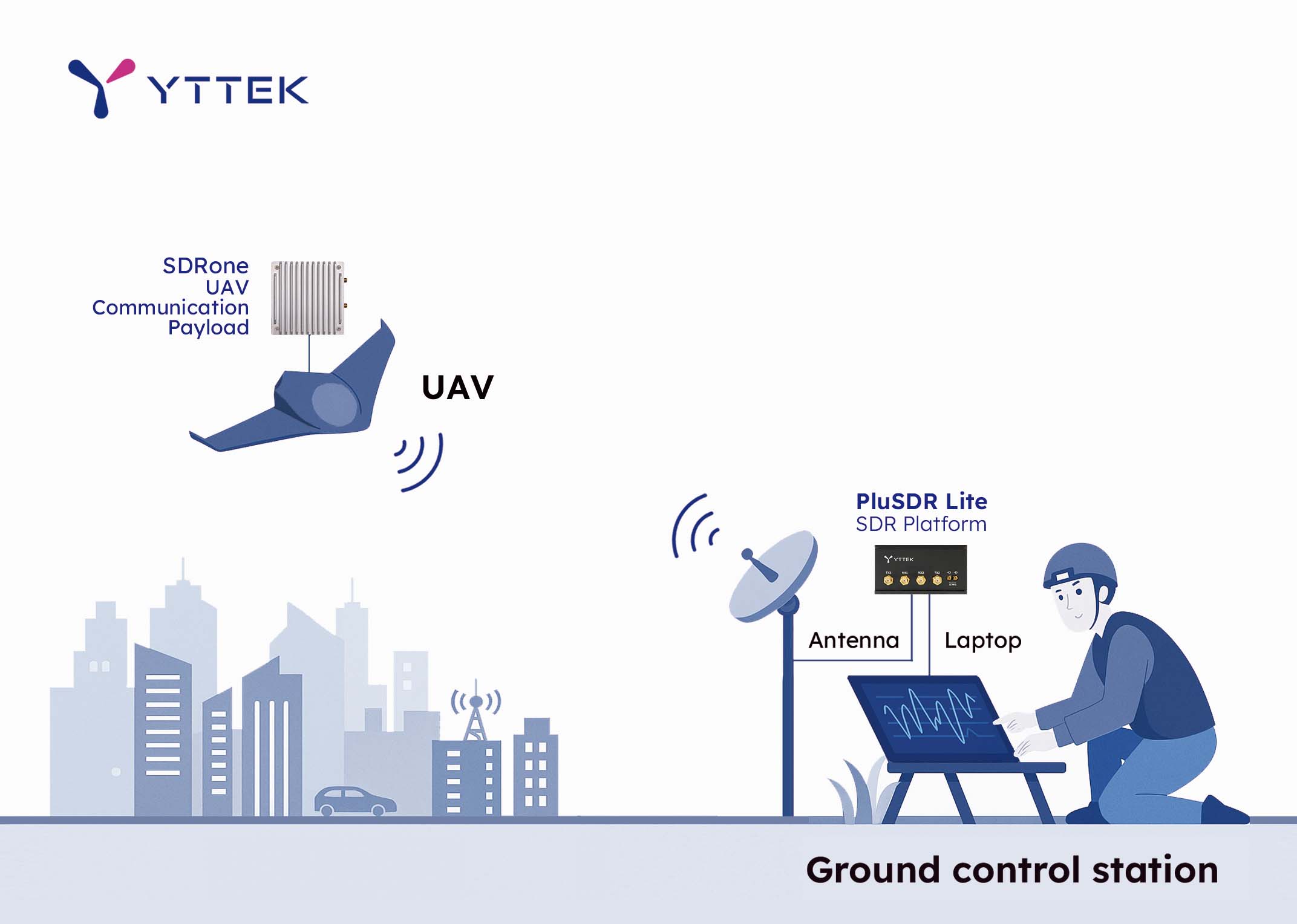
- Accelerated system integration and testing: Beyond deployment, SDR platforms support development and validation. For example, YTTEK’s PluSDR Lite SDR platform enables both simulation and real-world testing. It operates as a Vector Signal Generator (VSG) and Vector Signal Analyzer (VSA), allowing engineers to generate, analyze, and validate RF signals before deployment.
- Cost efficiency: Custom IC development for UAV communication modules involves high NRE (non-recurring engineering) costs and limited scalability. SDR-based architectures leverage FPGA platforms to deliver cost-effective, reusable, and multi-platform solutions.
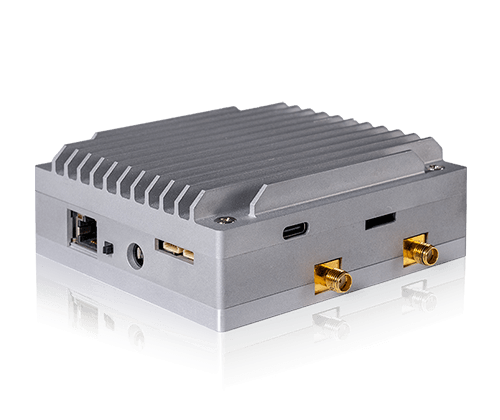
YTTEK SDRone: The advanced SDR UAV communication payload
YTTEK’s SDRone UAV communication module incorporates wideband frequency switching across the 300 MHz to 6 GHz range and further integrates high-speed frequency hopping at over 2,000 hops per second to ensure reliable, defense-grade communication in contested environments.
It is designed specifically for mission-critical UAV operations where link stability and anti-jamming performance are essential.
Key capabilities
- Anti-jamming performance: As a premier anti-jamming drone communication module, it utilizes frequency switching from 300 MHz to 6 GHz and high-speed hopping at over 2,000 hops per second to ensure stable links even in electronic warfare environments.
- C4ISR-ready architecture: Enables multi-drone coordination, edge computing, and point-to-multipoint (P2MP) communication.
- SWaP-C optimized design: A SWaP-C (Size, Weight, Power, and Cost) optimized drone payload engineered to be compact, lightweight, and power-efficient for seamless drone integration.
- Point-to-multipoint (P2MP): Enables one ground station to control multiple drones simultaneously.
- High data throughput: 7.5 Mbps supports real-time video streaming, telemetry, and data-intensive drone missions.
The adaptive nature of SDRone’s flexible SDR architecture also ensures high reconfigurability to meet evolving communication needs — from industrial applications to military operations.
Ready to elevate your mission resilience? Discover how YTTEK’s SDRone UAV Communication Module can secure your critical operations. Contact our experts today for detailed specifications and a customized solution.
Learn more about SDRone UAV Communication Module >
Learn more about PluSDR Lite SDR Platform >
⠀
Frequently asked questions
What is a UAV SDR?
A UAV SDR (Software-Defined Radio) is a communication system that uses software instead of fixed hardware to control radio functions, enabling flexible frequency, protocol, and waveform configuration.
Why is SDR important for UAV communication modules?
Software-Defined Radio (SDR) enables dynamic frequency agility, anti-jamming capability, and software-based reconfiguration, making UAV communication systems more resilient, adaptable, and future-ready.
How does SDR improve anti-jamming performance in drones?
SDR supports adaptive waveforms, frequency switching, and high-speed frequency hopping, allowing drones to maintain stable communication even in contested electromagnetic environments.
Can SDR reduce UAV communication system costs?
Yes. SDR minimizes hardware redesign requirements, reducing NRE (non-recurring engineering) costs while allowing a single UAV communication module to support multiple frequencies, protocols, and mission scenarios through software reconfiguration.
What makes SDRone different from traditional UAV communication modules?
SDRone combines anti-jamming capability, software-defined flexibility, and SWaP-C optimization, making it ideal for mission-critical UAV operations across diverse mission scenarios.