
Frequency switching in military drones: How advanced UAV communication modules counter jamming
Insights
Modern military drones—also known as unmanned aerial vehicles (UAVs)—operate in highly contested and hostile electromagnetic environments. To complete reconnaissance, targeting, surveillance, and strike missions, they rely on stable, secure, and resilient drone communication modules.
However, in today’s electronic battlefield, signal jamming and interference have become major threats to UAV survivability. This is why incorporating frequency switching capabilities into SDR-based drone communication modules enables dynamic adaptation and maintains stable connections under attack.
Why is jamming a critical risk for drone communication modules?
Military UAVs depend on real-time communication channels such as:
- Command-and-control (C2) links
- Telemetry data
- Mission-critical payload transmission
Disruption to these channels can result in:
- Loss of UAV control
- Data transmission failure
- Mission interruption
- Forced landing or asset loss
Modern adversaries use:
- High-power RF jamming
- GPS spoofing
- Spectrum congestion attacks
These techniques target fixed-frequency systems, making traditional radios highly vulnerable.
“Fixed-frequency communication is no longer sufficient. Modern drones require frequency switching drone communication modules to survive electronic warfare environments,” observed Jiangson Chen, CEO of YTTEK.
What is frequency switching in UAV communication modules?
Frequency switching is an anti-jamming technique that allows a UAV to change its operating frequency when interference is encountered.
A frequency-switching drone communication module can:
- Monitoring the signal quality in real time
- Automatically switch to a cleaner frequency
- Maintain uninterrupted communication
Frequency switching vs. traditional fixed-frequency communication
|
Feature |
Traditional fixed-frequency |
Frequency switching module |
| Interference resistance | Low | High |
| Frequency adaptability | Fixed | Dynamic |
| Jamming vulnerability | High | Low |
| Communication stability | Unreliable in EW (Electronic Warfare) | Stable under attack |
How does high-speed frequency hopping further improve anti-jamming performance?
Frequency switching provides the foundational layer of adaptability by enabling the system to move away from detected interference and maintain a stable communication link. When combined with high-speed frequency hopping, anti-jamming performance is further enhanced through continuous and rapid change of transmission frequencies:
- Frequencies randomly change thousands of times per second
- Signals appear as noise to external detection systems
- Jamming becomes ineffective without precise locked
Together, frequency switching and high-speed frequency hopping form a robust communication mechanism for electronic warfare–resilient UAV systems.
How does YTTEK SDRone UAV communication module implement frequency switching?
YTTEK’s SDRone UAV communication module incorporates wideband frequency switching across the 300 MHz to 6 GHz range and further integrates high-speed frequency hopping at over 2,000 hops per second to ensure reliable, defense-grade communication in contested environments.
It is designed specifically for mission-critical UAV operations where link stability and anti-jamming performance are essential.
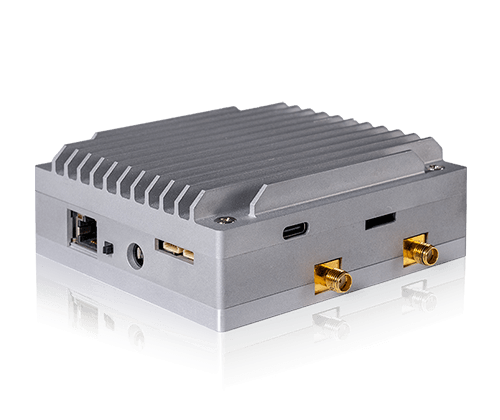
Key capabilities
- Anti-jamming performance: As a premier anti-jamming drone communication module, it utilizes frequency switching from 300 MHz to 6 GHz and high-speed hopping at over 2,000 hops per second to ensure stable links even in electronic warfare environments.
- C4ISR-ready architecture: Enables multi-drone coordination, edge computing, and point-to-multipoint (P2MP) communication.
- SWaP-C optimized design: A SWaP-C (Size, Weight, Power, and Cost) optimized drone payload engineered to be compact, lightweight, and power-efficient for seamless drone integration.
- Point-to-multipoint (P2MP): Enables one ground station to control multiple drones simultaneously.
- High data throughput: 7.5 Mbps supports real-time video streaming, telemetry, and data-intensive drone missions.
By combining frequency switching and high-speed frequency hopping, SDRone delivers defense-grade communication resilience for modern UAV systems.
Beyond defense: Why industrial drones also need frequency switching drone communication modules
Frequency switching is no longer limited to military drones. Industrial UAV applications increasingly operate in complex RF environments where communication reliability is critical.
Industries facing RF challenges:
- Energy infrastructure inspection
- Oil and gas monitoring
- Mining and underground operations
- Emergency response and disaster relief
- Long-range logistics and delivery
- Fish detection/Water quality monitoring
Common communication challenges:
- RF congestion
- Signal interference
- Coverage gaps
- Limited transmission range
Benefits of frequency switching in industrial drones:
- More stable connectivity
- Improved range and penetration
- Reduced signal loss risk
- Enhanced operational safety
Thus, frequency switching—once exclusive to defense drone communication—is rapidly becoming a must-have for industrial-grade drones as well.
Ready to elevate your mission resilience? Discover how YTTEK’s SDRone – a frequency switching drone communication module – can secure your UAV critical operations. Contact our experts today for detailed specifications and a customized solution.
Frequently asked questions
What is frequency switching in UAV communication?
Frequency switching is a technique that enables a UAV to dynamically switch its operating frequency in response to interference, maintaining stable communication links.
Why are traditional fixed-frequency UAV communication modules vulnerable?
Fixed-frequency UAV communication systems are vulnerable because they operate on a fixed frequency, making them easy to jam and unable to switch to alternative channels.
What makes the SDRone UAV communication module suitable for anti-jamming applications?
YTTEK’s SDRone incorporates wideband frequency switching across a 300 MHz to 6 GHz range, and further integrates high-speed frequency hopping of over 2,000 hops per second to ensure reliable, defense-grade communication in contested environments.
Can frequency switching be used in commercial or industrial UAVs?
Yes. Industries such as energy, mining, and logistics increasingly use frequency switching to improve reliability in RF-congested environments.